How we identify a sixgill
No two sixgills carry the same set of notches, scars and spots. We match those marks, side for side, against every shark in the catalog.
Filming a sixgill so we can match it
- Keep your light off its eyes. Light the body from above or the side.
- Get both sides. Marks on the left can only be matched against other left-side footage.
- Get the fins. The tail, the single dorsal fin and the pectoral fins carry most of the notches.
- Check male or female. See below.
- Note depth, time and site, then report the sighting with a link to the video.
Male or female? Film the pelvic fins
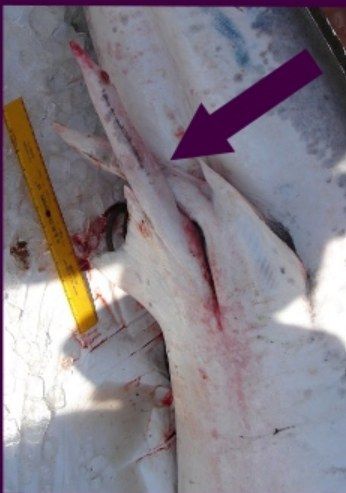
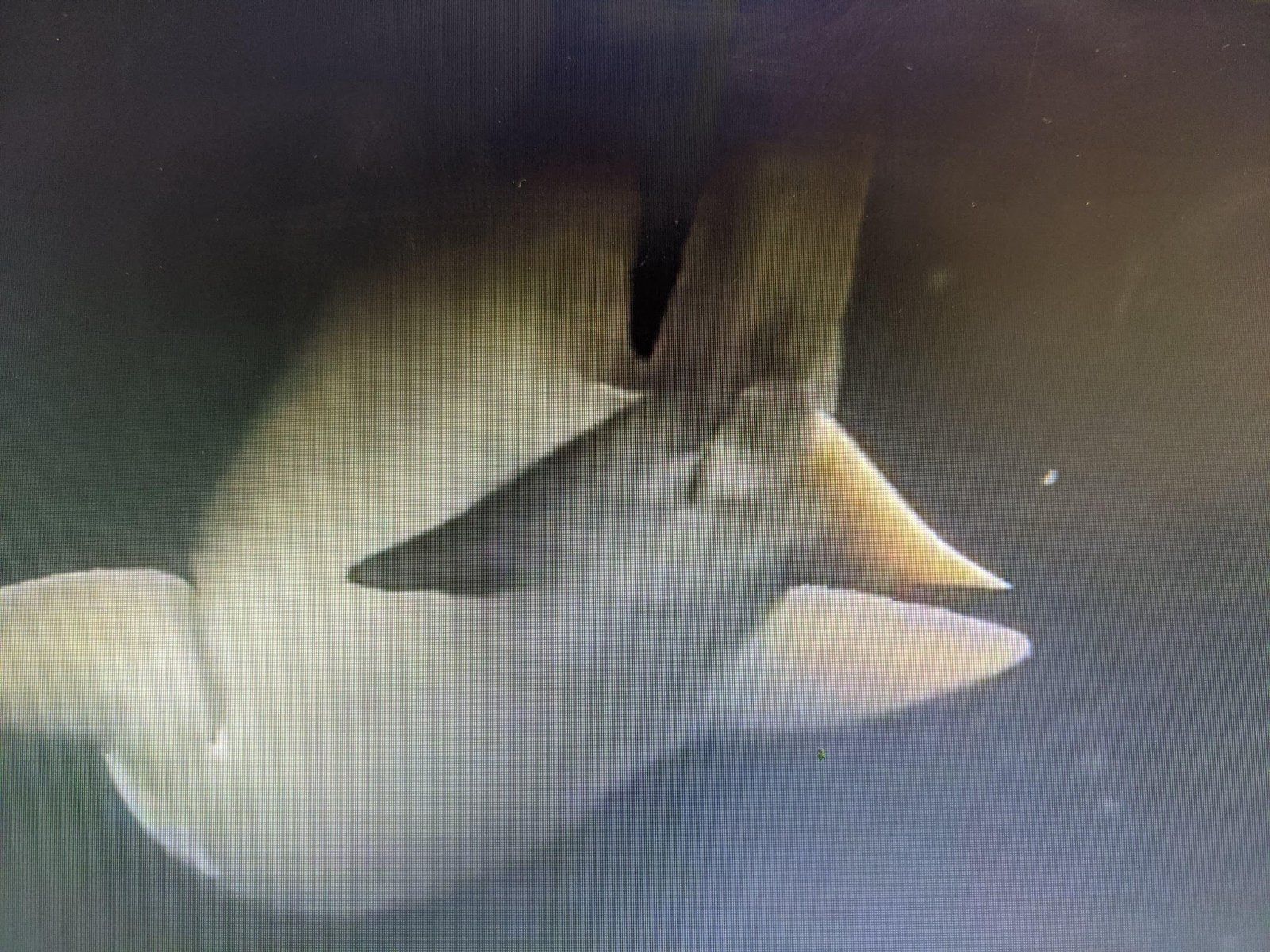
Males have claspers: two rod-like extensions on the inner edge of the pelvic fins, the pair of fins on the belly just ahead of the anal fin. Females don't have them. It's the only reliable way to tell, and it's often missing from our footage.
- Best angle: from the side and a little below, just behind the pelvic fins, as the shark swims past.
- A few seconds is enough. Keep the lower body in frame as it goes by.
- Stay put. Hold your position; don't chase the shark or swim under it to get the shot.
- On the report form, pick Male only if you saw claspers. If you couldn't see, choose Unknown.
Fin codes
Shark records describe marks with these codes. The diagram shows a sixgill's left side, head to the left.

| Code | Where |
|---|---|
| LPF | Left pectoral fin |
| RPF | Right pectoral fin |
| LPvF | Left pelvic fin |
| RPvF | Right pelvic fin |
| DF | Dorsal fin |
| AF | Anal fin |
| UCF | Upper lobe of caudal fin |
| LCF | Lower lobe of caudal fin |
| CF | Caudal fin (tail) |
| HD | Head, eyes and jaw |
| GS | Gill slits |
| BD | Body |
Where on the fin
Plain words work fine on the report form. These are the terms our notes use, so you'll see them on shark pages. The one that comes up most: a nick on the trailing edge.
| You might say | Our notes say |
|---|---|
| Front edge of the fin | Leading edge (anterior) |
| Back edge | Trailing edge (posterior) |
| Out at the tip | Distal |
| Where it joins the body | Base (proximal) |
| Top, back | Dorsal |
| Belly, underside | Ventral |
| Toward the head / tail | Anterior / posterior |
Shark listing policy
We do our best to include all reported sightings of sharks that include identifying information. In general, this requires pictures or videos. However, if you see sharks that were identified in previous years, we will include them in this year's sightings as well. We will do our best to credit the submitter, and the first person to submit a sighting for a shark is given the opportunity to name it! If we can't reach them, or they haven't picked a name within 14 days of our asking, the shark goes to Name That Shark and the community names it.
There are fewer sharks listed here than are submitted due to lack of videos, pictures, and identifying information. That's OK! Every sighting is important data, even if it doesn't get listed here.
Catalog IDs
Every shark gets an ID from where and when it was first catalogued: species, location, year, number. SG-R-24-03 is a sixgill (SG), first seen at Redondo (R) in 2024, the third new shark that year.
The ID never changes, even if the shark turns up somewhere else later. Every later sighting is added to that shark's log.
| Code | Location |
|---|---|
| A | Alki |
| DP | Dash Point |
| HC | Hood Canal (all sites) |
| T | Owen Beach |
| PR | Point Ruston |
| R | Redondo |
| SW | Saltwater State Park |
| S | Sund Rock |
| W | Whytecliff |